Free tool
Pipe slope and invert level calculator
Enter any three of upstream invert, downstream invert, reach length and gradient — the calculator solves the fourth and shows the slope as 1:n, %, ‰ and mm/m at the same time, in metric or imperial. Below it, paste your whole manhole schedule and watch the long section (plan-and-profile users: the profile) draw itself, with cover depth at every point. No sign-up.
Single reach
Pick what to solve for, then fill in the other three.
Result
Downstream invert level: 99.850 m AOD
Fall over the reach: 0.150 m
The same gradient, written four ways
- ‰
- 5.00
- %
- 0.500
- 1:n
- 1:200
- mm/m
- 5.00
Manhole schedule — the whole run
Paste a table from your spreadsheet (name, chainage or station, ground level, invert level) or edit the rows by hand. Each reach gradient is computed for you; typing a gradient fills the inverts down the run.
| Manhole | Chainage [m] | Ground level | Invert level | Cover [m] | Gradient to next |
|---|---|---|---|---|---|
| 2.10 | ‰ | ||||
| 2.04 | ‰ | ||||
| 1.88 | ‰ | ||||
| 1.65 | — |
Live long section (profile)
Vertical scale exaggerated ×10, as on a 1:100 / 1:1000 long section.
ground pipe invert
| Manhole | Chainage [m] | Ground level | Invert level | Cover [m] | Gradient to next |
|---|---|---|---|---|---|
| S1 | 0.00 | 102.40 | 100.10 | 2.10 | 5.00 ‰ |
| S2 | 48.00 | 102.10 | 99.86 | 2.04 | 5.00 ‰ |
| S3 | 96.00 | 101.70 | 99.62 | 1.88 | 5.00 ‰ |
| S4 | 150.00 | 101.20 | 99.35 | 1.65 | — |
Open this profile in Altivo
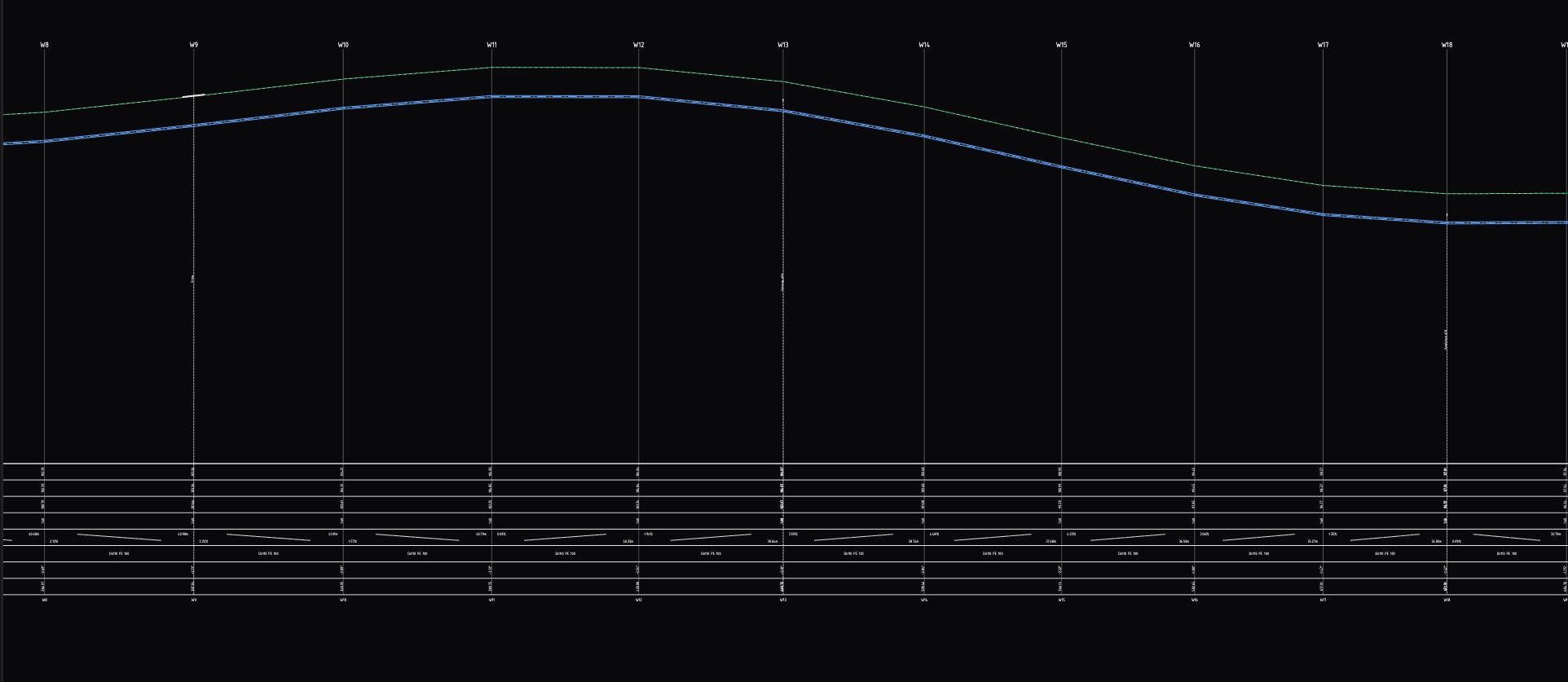
Your points go straight into the editor — add crossings, chambers and structures, then download a clean DXF for CAD.
Got your levels? Altivo turns them into a full long section and a DXF — 14 days free.
Start freeWhat an invert level is, and how the gradient follows from it
[Invert level](/en/glossary/invert-level) — invert elevation in US practice — is the height of the inside bottom of the pipe at a given point, quoted in the same datum as the ground level (m AOD in the UK, NAVD 88 in the US). Ground level minus invert level, less the outside diameter of the pipe, is the cover. On a long section the invert is resolved at every manhole and carried between them by a constant gradient over each reach.
One formula does the work: downstream invert = upstream invert − gradient × horizontal length. The gradient is dimensionless, so 1:200 goes in as 0.005 and 0.5% as 0.005 too.
Worked example. MH1 has an invert of 100.00 m AOD. The reach to MH2 is 30 m long and laid at 1 in 200. Then 100.00 − 0.005 × 30 = 99.85 m AOD, a fall of 150 mm. Read the other way: with both inverts known, the gradient is (100.00 − 99.85) ÷ 30 = 0.005, i.e. 1:200, 0.5%, 5 mm/m.
Two habits save rework. Length here is the horizontal length — the difference in chainage (station, in US practice), not the sloping length of the pipe; at sewer gradients the two barely differ, at a few percent they do. And DN is not the outside diameter: cover is measured over the crown, not over the invert.
Gradient units: 1 in n, %, ‰ and mm/m
UK drawings and specifications lead with the 1 in n ratio (a "fall of 1 in 80"); US plan-and-profile sheets normally use % or ft/ft; continental European standards write ‰, which is numerically the same as mm/m. The calculator shows all of them at once so nothing is lost in translation between a specification and a drawing.
The same gradient in every notation
| 1 in n | % | ‰ (mm/m) | ft/ft | in/ft |
|---|---|---|---|---|
| 1:40 | 2.5 | 25 | 0.025 | 0.30 |
| 1:80 | 1.25 | 12.5 | 0.0125 | 0.15 |
| 1:100 | 1.0 | 10 | 0.010 | 0.12 |
| 1:150 | 0.67 | 6.7 | 0.0067 | 0.080 |
| 1:200 | 0.5 | 5 | 0.0050 | 0.060 |
| 1:300 | 0.33 | 3.3 | 0.0033 | 0.040 |
| 1:500 | 0.2 | 2 | 0.0020 | 0.024 |
Conversions: % = 100 ÷ n, ‰ = 1000 ÷ n, in/ft = 12 ÷ n. One foot is exactly 0.3048 m.
Minimum gradient by pipe size — guidance, not approval
The calculator flags a reach laid flatter than the 1-in-DN rule (known in the UK as Maguire’s Rule): the minimum gradient of a gravity public sewer is roughly 1:DN, so DN200 gets about 1:200 and DN300 about 1:300. It is a starting value for pre-dimensioning, not a verification.
Do not confuse these with the steep 1:40 and 1:80 falls of private and building drainage inside the plot (UK Approved Document H — roughly 1:40 for 100 mm and 1:80 for 150 mm pipes). Those runs rarely flow full, which is why they are graded harder; applying 1:80 to a DN400 trunk sewer would bury it needlessly deep.
The binding check under EN 752 is self-cleansing velocity at the design flow — on the order of 0.7 m/s (about 2.3 ft/s) at partial fill. In US practice the Ten State Standards (Recommended Standards for Wastewater Facilities) publish minimum slopes sized for 2.0 ft/s: 0.40% for 8 in, 0.28% for 10 in, 0.22% for 12 in, 0.15% for 15 in, 0.12% for 18 in, 0.10% for 21 in and 0.08% for 24 in. Confirm against the current edition of whichever applies to you.
1-in-DN (Maguire’s Rule)
| DN [mm] | Ratio | % | ‰ | mm/m |
|---|---|---|---|---|
| 100 | 1:100 | 1.0 | 10 | 10 |
| 150 | 1:150 | 0.67 | 6.7 | 6.7 |
| 200 | 1:200 | 0.5 | 5 | 5 |
| 225 | 1:225 | 0.44 | 4.4 | 4.4 |
| 250 | 1:250 | 0.4 | 4 | 4 |
| 300 | 1:300 | 0.33 | 3.3 | 3.3 |
| 400 | 1:400 | 0.25 | 2.5 | 2.5 |
| 500 | 1:500 | 0.2 | 2 | 2 |
| 600 | 1:600 | 0.17 | 1.7 | 1.7 |
Sources: the 1-in-DN rule of thumb, EN 752 (self-cleansing velocity), Approved Document H for private drainage, Ten State Standards for US minimum slopes. More detail: minimum sewer slope by pipe size and gravity sewer gradients.
Frequently asked questions
How do you calculate the downstream invert level?
Downstream invert = upstream invert − gradient × horizontal length. The gradient goes in dimensionless, so 1 in 200 is 0.005. With an upstream invert of 100.00 m AOD, a 30 m reach at 1:200 gives 100.00 − 0.15 = 99.85 m AOD.
How do I convert a 1 in 80 fall to a percentage?
Divide 100 by n: 1 in 80 is 1.25%, or 12.5 mm/m (12.5 ‰), or 0.15 in/ft. Going the other way, n is 100 divided by the percentage, so a 0.5% gradient is 1 in 200.
What is the minimum gradient for a 225 mm sewer?
By the 1-in-DN rule (Maguire’s Rule) about 1:225, which is 0.44% or 4.4 mm/m. That is a starting value for pre-dimensioning; the binding check is self-cleansing velocity at the design flow under EN 752, around 0.7 m/s, or the minimum slope table in your local code.
Is invert level the same as invert elevation?
Yes — invert level is the UK term and invert elevation the US one, and both mean the height of the inside bottom of the pipe. What differs is the datum (m AOD versus NAVD 88 feet) and the surrounding vocabulary: chainage and long section in the UK, station and plan and profile in the US.
Why does my gradient come out negative?
A negative gradient means the invert rises in the direction of flow, which is an adverse fall on a gravity run. The usual causes are manholes entered in the wrong order or the two inverts swapped. Where the ground drops sharply, a drop manhole is normally cleaner than running one reach very steep.
Designing a run? Draw the whole long section from these levels
Paste coordinates and levels, set gradients and depths, add crossings and structures — then download a clean DXF for CAD. 14 days free, no card.
This calculator handles one reach. Altivo carries the whole run: drop manholes, branches, the profile data band and the export.
Try Altivo for free